Samuel Samuzzo Amatuna
The story of a flashy Chicago gangster who killed his first man at age 17, then rose to the top of mobsterdom -- only to find that not only is it lonely at the top, but dangerous.
by Allan May
"In the first place, according to the ‘boys in the racket,’ Samoots was the most generous of them all," said a close friend. He would go to the local barbershop and buy the boys haircuts and shaves. Samoots would then ask someone to help him pick out a new suit and then buy that man one to match. "He never knew when to stop giving," another friend said, "Those who knew him said his hands were always open and he always had a smile."
But, if he wanted someone removed… "Sure," said one of his intimates, "If he wanted a guy knocked off, he’d have him knocked off, what the hell? But he was a good guy just the same."
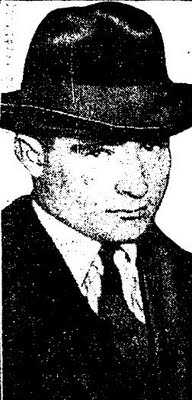
Samoots, whose real name was Samuel Samuzzo Amatuna, had a short but colorful career in the Chicago underworld. Called the "Beau Brummel of Little Italy" by the newspapers, his rise and fall paralleled that of the Genna gang of Chicago, a family of six brothers with a ruthless reputation with whom Amatuna was once closely associated.
Not much is known about Amatuna’s early life; it’s believed he was born in Pogallo, Sicily in 1899. In The One-Way Ride, Walter Noble Burns describes him:
"Samoots Amatuna – the name sounds like a chord on a guitar – was musical and murderous, a gay, light-hearted troubadour, and one of the most treacherous and cold-blooded killers in gangland. When someone remarked on the loudness of his garments, the flashy Samoots, glittering with diamonds worth a small fortune replied that he had a musical taste in clothes. He sang with technical correctness in a voice of fine lyric quality. He was a finished performer on the violin and a member of the musicians’ union. He also showed an unusual talent with the sawed-off shotgun, and for a long time his friends were in doubt whether Samoots would wind up on the operatic stage or the gallows."
Amatuna was once arrested with four other musicians after they tried to murder the business agent of their musicians’ union. Another story about Amatuna was that he was a fastidious dresser and owned some 200 monogrammed silk shirts. Once, a Chinese laundry returned a shirt to him that had been scorched by an iron. Amatuna was said to have run into the street after the driver of the horse drawn delivery wagon. After catching up with the driver, he pulled a revolver and aimed it at him. Amatuna suddenly regained his senses and then shot the horse.
In 1916, at the age of 17, Amatuna’s rise in the crime world began when he was credited with the murder of Frank Lombardi, a political ward heeler, on Feb. 21. Five years later, on March 8, 1921, he was a participant in a Genna hit team that killed both Paul A. Labriola and Harry Raimondi in separate incidents. In the Maxwell Street neighborhood where he was so popular, Amatuna had the reputation of a tough guy who never carried a gun.
Over the next few years, Amatuna played a major role in the Genna gang’s rise to prominence in both the Chicago bootlegging underworld and in the leadership of the Unione Siciliano. The Unione was established in New York City during the 1880s. The organization mixed fraternal and benevolent activities and became a sort of social agency with a membership exclusive to Sicilian immigrants. The Unione’s large membership gave it political clout and in Chicago many of the members were bootleggers. The presidency of the Unione was a coveted position among aspiring Sicilians. Al Capone, because of his Neapolitan heritage, could not become a member of the Unione and during the mid-1920s he waged a war to get his own man in as president.
On Nov. 8, 1924, Mike Merlo, who was president of the Unione Siciliano, died of cancer. Using Merlo’s death as an excuse to come to Chicago, Frank Yale, who was the national head of the Unione in New York City and a good friend of Capone and Johnny Torrio, slipped into town to pay his respects. Yale ordered flowers for the funeral and on Nov. 10 went to Dion O’Bannion’s flower shop to pick them up. While there, he and two Genna gunmen, John Scalise and Albert Anselmi, murdered O’Bannion, the North Side boss and archrival of Torrio and Capone.
Police grabbed Yale at the train station, as he was about to leave town. After being brought in for questioning, Amatuna provided an airtight alibi for Yale by claiming they had lunch together at the Palmer House restaurant at the time O’Bannion was killed. Amatuna also provided a waiter who swore to their presence there, even recalling what they ordered.
Much to the displeasure of Capone, the Gennas’ quickly assumed the leadership of the Unione. Angelo Genna held the position until he was shot on the morning of May 25, 1925. In the wake of Angelo’s murder, Amatuna seized the opportunity to make himself head of the Unione Siciliano. He hired two body guards, Edward Zion, and Abraham Goldstein, then walked into the Unione headquarters and proclaimed himself boss.
The real muscle of the Genna gang came from the killing duo of Scalise and Anselmi, who were facing two separate trials for the recent murders of two police officers. Amatuna busied himself and his men with raising $100,000 for their legal defense. While this was going on, another Genna brother was murdered, the third in 44 days, and the remaining three brothers fled town. This left Amatuna with the unenviable task of trying to regroup the remnants of the Genna organization.
In addition to rebuilding an underworld empire left in shambles, Amatuna was also planning his wedding, which was to "set a new high-mark in the festivities of the kind." Amatuna was engaged to Rose Pecorara, the sister-in-law of the late Unione president Mike Merlo. The wedding was planned for the previous December, but was postponed when Merlo passed away.
On Tuesday night, Nov. 10, Amatuna and his fiancée had tickets to attend the opera to hear Aida. As was his custom before any social event, Amatuna visited his barber at the corner of Halsted and Roosevelt. After receiving a shave and a manicure, Amatuna was preparing to leave when two men entered the busy shop and drew guns. As the pair started shooting, Amatuna ducked behind a chair while barbers and customers dove for cover. Both gunmen fired four times each, but only one bullet struck Amatuna, entering his neck and exiting his back below the shoulder blade. Friends of Amatuna’s standing outside the shop rushed in after the gunmen fled and carried him to a taxi. The still conscious Amatuna ordered them to stop first at a cigar shop on Taylor Street. There two men got in and rode to the hospital with him, but took off once they arrived.
At Jefferson Park Hospital, Dr. Gaetano Rongo, the future father-in-law of Chicago Outfit boss Frank Nitti, attended to Amatuna. The bullet that entered Amatuna’s neck passed close to his spinal cord. Doctors feared that if he lived he would be paralyzed. Amatuna lingered through Wednesday, but by Thursday afternoon he knew he was dying. His brother had spent the afternoon canceling wedding arrangements that had been made for the following week. Meanwhile, preparations were underway for a deathbed wedding for late Thursday night. Before the ceremony could begin, Amatuna slipped into a coma. At 2 a.m. Friday morning he was pronounced dead.
The wake was held on Nov. 16 at Miss Pecorara’s home where $20,000 worth of floral arrangements spilled out onto the front lawn, back lawn and neighbor’s lawns. The following day the funeral cortege wove its way through Little Italy passing the barbershop where Amatuna was shot. The procession ended at Mount Carmel Cemetery where Amatuna was placed in a temporary vault. His body would soon be sent home to his native Sicily where it would be buried in consecrated ground with much pomp. Apparently Amatuna’s generosity had spilled over to family and friends there too.
A friend of Amatuna’s, speaking anonymously, told a reporter after the shooting, that the relationship between Amatuna and the Genna’s had soured sometime before Amatuna took over the Unione. Amatuna had confided to a policeman friend that he was in debt some $22,000 due to the money he had to cough up for the Scalise and Anselmi defense fund. Meanwhile, the police, incensed over the killing of two fellow officers, kicked over all of the stills in the Maxwell Street territory of the Gennas. Amatuna complained, "More than half of those stills were mine." The friend stated that each time Amatuna set up a new still, "it cost him $800 to $1,000, and every time he set one up the police came along and kicked it over again."
After Amatuna’s funeral his ex-bodyguards were next to go. On Nov. 18, after returning from the funeral, two men shot Edward Zion to death in his driveway at 2 a.m. Two days later, Abraham Goldstein was shot twice in the head while waiting in a drug store. He died instantly.
Over the years the killers of Amatuna were believed to be Jim Doherty of the West Side O’Donnell gang and Vincent Drucci of the North Side gang. In his book Mr. Capone, author Robert Schoenberg presents a logical argument that the killers were actually members of the Capone mob instead of Doherty and Drucci’s. Whatever the case, Capone was certainly the one who benefited. First he was able to get his own man into the presidency of the Unione Siciliano, and second he now had the Genna’s "fabulously profitable alky-cooking empire" to himself.
The day Amatuna died, the Chicago Daily Tribune predicted that his funeral would be a "distinguished hail and farewell" and that his killers would be seated in the front row, "weeping copiously and strewing wreaths of much cost." Amatuna probably would not have minded this, having often been in the same position himself.
Copyright 1999 A. R. May | Posted July 14, 1999