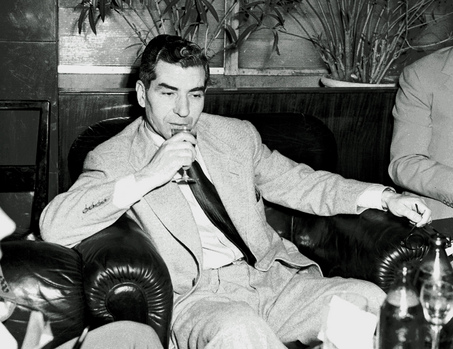
Lucky Luciano
Despite what some academics still contend, it's more fable than fact that Lucky Luciano was behind the massacre of mob leaders that became known as the Night of Sicilian Vespers.
by Allan May
I became fascinated by the "Night of Sicilian Vespers" after reading about it in the book Murder, Inc. during the mid-1980s. I repeated the story to friends at work, speaking like an authority and explaining how the Mafia didn’t exist anymore because it was wiped out back in 1931 on the day that Salvatore Maranzano, the Boss of Bosses, the "capo de tutti capo," was murdered in his Park Avenue office. September 10, 1931 was the day of "The Americanization of the Mobs."
Over the years though I became curious. Who were the 40 individuals who perished in one night of butchery? After all, look at the attention the St. Valentine’s Day Massacre generated, and that was only seven people.
Fast forward to 1990, I’m heading to a bookstore in Manhattan that has a copy of "The Last Testament of Lucky Luciano" set aside for me. Surely the semi-reluctant Boss of Bosses will set this matter straight for me. He’s the one who ordered the deaths to begin with. Rushing back to my hotel, I begin to read Lucky’s response, "All that stuff them writers always printed about what they called the ‘Night of Sicilian Vespers’ was mostly imagination. Every time somebody else writes about that day, the list of guys who was supposed to have got bumped off gets bigger and bigger. The last count I read was somewhere around fifty. But the funny thing is, nobody could ever tell the names of the guys who got knocked off the night Maranzano got his. I, personally, don’t know the name of one top guy in the Maranzano group in New York or Chicago or Detroit or Cleveland or nowhere who got rubbed out to clear the decks."
The book goes on to say that the only person that was murdered that night was Gerardo Scarpato, the owner of the Nuova Villa Tammaro restaurant in Coney Island. It was in his restaurant that Luciano had set up Joe "The Boss" Masseria to be murdered on April 15, 1931. Scarpato was found strangled in a burlap sack that was tossed into an abandoned car in Brooklyn.
Hmmm! Now I felt a little foolish having repeated that story so often. Wait a minute! If I were responsible for having 40 people killed in a single night, would I admit to it? Maybe Lucky wasn’t telling the whole truth. There were other flaws in his "testament."
After arriving home, I looked at my original source for the tale. Burton Turkus, the Assistant District Attorney of Kings County who helped prosecute the "Murder, Inc." members, stated in his 1951 book, "The day Maranzano got his, it was the end of the line for the Greaser Crowd in the Italian Society – the finish of ‘The Moustache Petes’ – and a definite windup to the Mafia as an entity and a power in national crime. For in line with Lucky’s edict – some thirty to forty leaders of the Mafia’s older group, all over the United States, were murdered that day and in the next 48 hours!"
Now why would a prominent prosecutor make this stuff up? Who was I going to believe one of the good guys or the treacherous Luciano? Turkus did say that the killings took place that night and over the next 48 hours. Maybe Luciano was pulling a fast one, he only mentions that no one was killed the night Maranzano died.
I believe Gang Rule in New York, by Craig Thompson and Allen Raymond, was the first book to discuss the murders. The authors stated, "That was the day on which the principal greasers were liquidated. The Americanization campaign bumped into an important snag, for in the Unione there were many old-line leaders or men of importance who, clannish and illiterate, had no sympathy for the ideas of cooperation that the younger and far-sighted members of the Unione were advocating. These old fogies were called the ‘greasers’ by the younger generation."
In 1963, informer Joseph Valachi, a Genovese Crime Family member, testified before the McClellan Committee about his life in organized crime. Peter Maas wrote The Valachi Papers, reporting Valachi’s testimony, "The murder of Maranzano was part of an intricate, painstakingly-executed mass extermination engineered by the dapper, soft-spoken, cold-eyed Charlie "Lucky" Luciano. On the day Maranzano died, some forty Cosa Nostra leaders allied with him were slain across the country, practically all of them were Italian-born old-timers eliminated by a younger generation making its bid for power."
In 1969, Donald R. Cressey, a Professor of Sociology at the University of California, Santa Barbara, and a consultant to the President’s Commission on Law Enforcement and Administration, wrote Theft of a Nation: The Structure and Operations of Organized Crime in America. The good professor informs us that, "The Maranzano slaying was not an isolated incident. It was part of the last major battle of a war. The day Maranzano was killed has long been known as ‘purge day’ in Cosa Nostra. On that day and the two days immediately following, some forty Italian-Sicilian gang leaders across the country lost their lives in battle. Most, if not all, of those killed on the infamous day occupied positions we would now characterize as ‘boss,’ ‘underboss,’ or ‘lieutenant.’"
Each new book seemed to reveal new information about the mass murders except who got killed and where.
As late as 1975, the story was still making the rounds. In Brothers In Blood: The Rise of the Criminal Brotherhoods, author David Chandler puts a bizarre spin on the episode. Chandler states that there were 60 victims. He writes, "Each of the sixty victims must have been kept under surveillance to establish his daily pattern. For each of the sixty, a hit team had to be organized and gunmen chosen who wouldn’t betray the plan. When Purge Day arrived, the hit teams had to be delivered to their target’s area. A communications liaison must have been worked out to relay the go-ahead message from New York – that Maranzano had been killed – to each of the teams. At least 300 hundred men must have been in on the plot. Yet it went off without a hitch, so smoothly that it took more than a year before the first hint of a brotherhood purge filtered out to police. One reason the shake-up went off so quietly was that in many cases it took days, even months, before the bodies were discovered. Some of the bodies have never been found."
Wow! Would you believe Chandler once won a Pulitzer Prize in 1962 for investigative reporting?
In 1976, the mystery was finally solved by a history professor from the University of Kentucky by the unlikely name of Humbert S. Nelli. Working on a grant from the National Endowment for the Humanities and the Kentucky Research Foundation, Nelli traveled to 14 cities and performed an extensive examination of Italian criminal activity. His work culminated in the book, The Business of Crime: Italians and Syndicate Crime in the United States.
In Nelli’s research he traced down the origin of the tale. In 1939, Dixie Davis, the former lawyer for New York gangster Dutch Schultz, told Collier’s magazine that former Schultz gunman Abe "Bo" Weinberg discussed the killings with him. According to Davis, Weinberg, who participated in the Maranzano murder, stated that the killing "began a nationwide attack on the old-timers. In fact, ‘at the very same hour’ as Maranzano’s death, ‘there was about 90 guineas knocked off’ all over the country."
We now have the origin of the fable, but who were the murder victims, of which there are now 90?
Nelli’s research revealed that three men in the New York area were murdered on September 10. Samuel Monaco and Louis Russo’s bound bodies were found in the Hackensack River, and James La Pore had been murdered on a Bronx street. In addition to Maranzano and Scarpato that was New York’s portion of the purge. This appears to have been the extent of the great massacre.
Part of Nelli’s research was an extensive review of newspapers in the following cities; Baltimore, Boston, Chicago, Cleveland, Denver, Detroit, Kansas City, Los Angeles, New Orleans, Philadelphia, Pittsburgh, and San Francisco. This review of newspapers covered the months of September, October and November 1931. His findings showed that only one murder occurred during this period that could only remotely be tied to the purge and that was in Denver.
We’ll never know the motivation behind the fairy tale Bo Weinberg presumably started. A few years after the fictional purge Bo himself was purged by his boss Dutch Schultz. Many believe he was given a cement foot bath and tossed into the East River. Whatever the disposal method may have been, Weinberg was never around to tell mob bedtime stories again.
ã 1999 – A. R. May