
 February 7, 2013 | LA Times
Authorities continued to comb Big Bear on Thursday as an intensive manhunt for an ex-Los Angeles police officer suspected in a series of shootings stretched into late afternoon.
Christopher Jordan Dorner, 33, is suspected of shooting three police officers, one of whom died, in Riverside County early Thursday. Police say he also shot and killed the daughter of a former LAPD captain and her fiance in Orange County earlier this week.
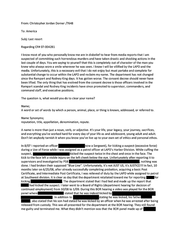
The Los Angeles Police Department is examining a manifesto it said was published on what the agency believes is Dorner's Facebook page.
The rambling document threatened "unconventional and asymmetrical warfare" against police. Authorities have dispatched protective details to at least 40 officers and others named.
The postings threaten violence against other police officers.
“The violence of action will be high.... I will bring unconventional and asymmetrical warfare to those in LAPD uniform whether on or off duty,” one passage said.
The manifesto also seemed to allude to the Irvine slaying on Sunday.
“I know most of you who personally know me are in disbelief to hear from media reports that I am suspected of committing such horrendous murders and have taken drastic and shocking actions in the last couple of days,” one passage said.
“Unfortunately,” it went on, “this is a necessary evil that I do not enjoy but must partake and complete for substantial change to occur within the LAPD and reclaim my name.”






2 comments on "Ex-cop manhunt: Read the manifesto"
The women, shot in the 19500 block of Redbeam Avenue, were taken to area hospitals, Torrance police Lt. Devin Chase said. They were not identified. One was shot in the hand and the other in the back, according to Jesse Escochea, who captured video of the victims being treated.
It was not immediately known what newspapers the women were delivering. After the shooting, the blue pickup was riddled with bullet holes and what appeared to be newspapers lay in the street alongside.
PHOTOS: Manhunt for ex-LAPD officer
Local, state and federal authorities are involved in a massive search for Christoper Jordan Dorner, 33, a former Los Angeles Police Department officer who is believed to have threatened "unconventional and asymmetrical warfare" against police in an online manifesto, and was suspected of shooting three police officers, one of whom died, early Thursday in Riverside County.
Dorner also is suspected of killing a couple in Orange County earlier this week.
Sources said the Los Angeles police detectives involved in the Torrance shooting were on protective detail for a police official named in the suspect's supposed manifesto, which was posted on what authorities believe is his Facebook page. Read More
Disgruntled former L.A.P.D. officer Christopher Dorner is reportedly barricaded in a mountain cabin after shooting two deputies during a gun battle this afternoon, according to the San Bernardino County sheriff's office.
Authorities have the cabin surrounded near Big Bear Lake, which is about 100 miles northeast of Los Angeles. Dozens of SWAT officers have been sent to the scene.
An unidentified source told the the L.A. Times that the shooting occurred after Dorner burglarized a home, tied up a couple and stole their car. A spokeswoman with the San Bernardino Sheriff's Office said that two officers were being transported via air ambulance. Their conditions were not known.
"Suspect is pinned down next to the shooting scene," a San Bernardino dispatcher said over a police radio channel. "Marshals have a positive ID and visual of the suspect."
A 3-mile-wide perimeter has been set up by police, and authorities were asking news helicopters not to broadcast live video of the cabin.
Residents in the area were being told to stay inside and lock their doors. The California Highway Patrol has closed all highways near the scene.
"People should stay away from that area. It is not safe right now," a police spokeswoman told KTLA-TV.
Dorner has been on the run for seven days. He is accused of killing three people--including one police officer--last week.
The 33-year-old former naval and LAPD officer turned triple-murder suspect, has been at the center of a massive manhunt stretching from the San Bernardino Mountains—where his burned-out pickup truck was found last week—to the Mexican border.
In a manifesto posted online earlier this month, Dorner promised "unconventional and asymmetrical warfare" against the LAPD, which fired him in 2008. On Saturday, actor Charlie Sheen—who was mentioned in Dorner's online manifesto—released a video pleading with the accused killer to call him.
On Saturday, police conducted a door-to-door search for Dorner in Big Bear Lake, Calif., but snowfall hampered their efforts in the surrounding mountains.
On Sunday in Los Angeles, an increased police presence was seen at the Grammy Awards, which some thought Dorner might target. In Northridge, Calif., a home improvement store was evacuated after a report of a possible Dorner sighting, hours after the LAPD announced a $1 million reward for information leading to his arrest.
"This is the largest local reward ever offered, to our knowledge," Los Angeles Police Chief Charlie Beck said at a news conference. "This is an act of domestic terrorism. This is a man who has targeted those that we entrust to protect the public. His actions cannot go unanswered."