J. J. Maloney

J. J. Maloney, an award-winning journalist and founder and editor of Crime Magazine, passed away December 31, 1999, at his mother's home in Webster Groves, Mo. He was 59. Read More About JJ Maloney here.

Sharon Kinne: La Pistolera

Kinne2.gif (3301 bytes)

Sharon Kinne

She was one of the most remarkable criminals in U.S. history. A housewife, she turned cold-blooded killer. In 1969 she escaped from a Mexican prison and disappeared without a trace.

by J. J. Maloney

In 1960 Sharon Kinne was an attractive 20-year-old Jackson County, Mo., housewife with two children, and was having an affair with John Boldizs, a friend from high-school.

She and her husband, James, 25, were having frequent arguments.  Sharon wanted a new Thunderbird, and she wanted a vacation trip.  She often lied about having paid bills.  The Kinnes were deeply in debt.

On March 19, 1960 -- a Saturday afternoon – James, who – his relatives say -- knew she was cheating on him, reportedly told Sharon he would file for divorce the following Monday.

So Sharon Kinne did the only sensible thing, for her: She shot James in the head while he was napping and said her 2-year-old daughter Danna did it while playing with daddy's gun -- a .22-caliber Hi-Standard pistol. When the Jackson County Sheriff’s deputies arrived at the house just east of Independence, Mo., they found the gun lying on the bed beside James.

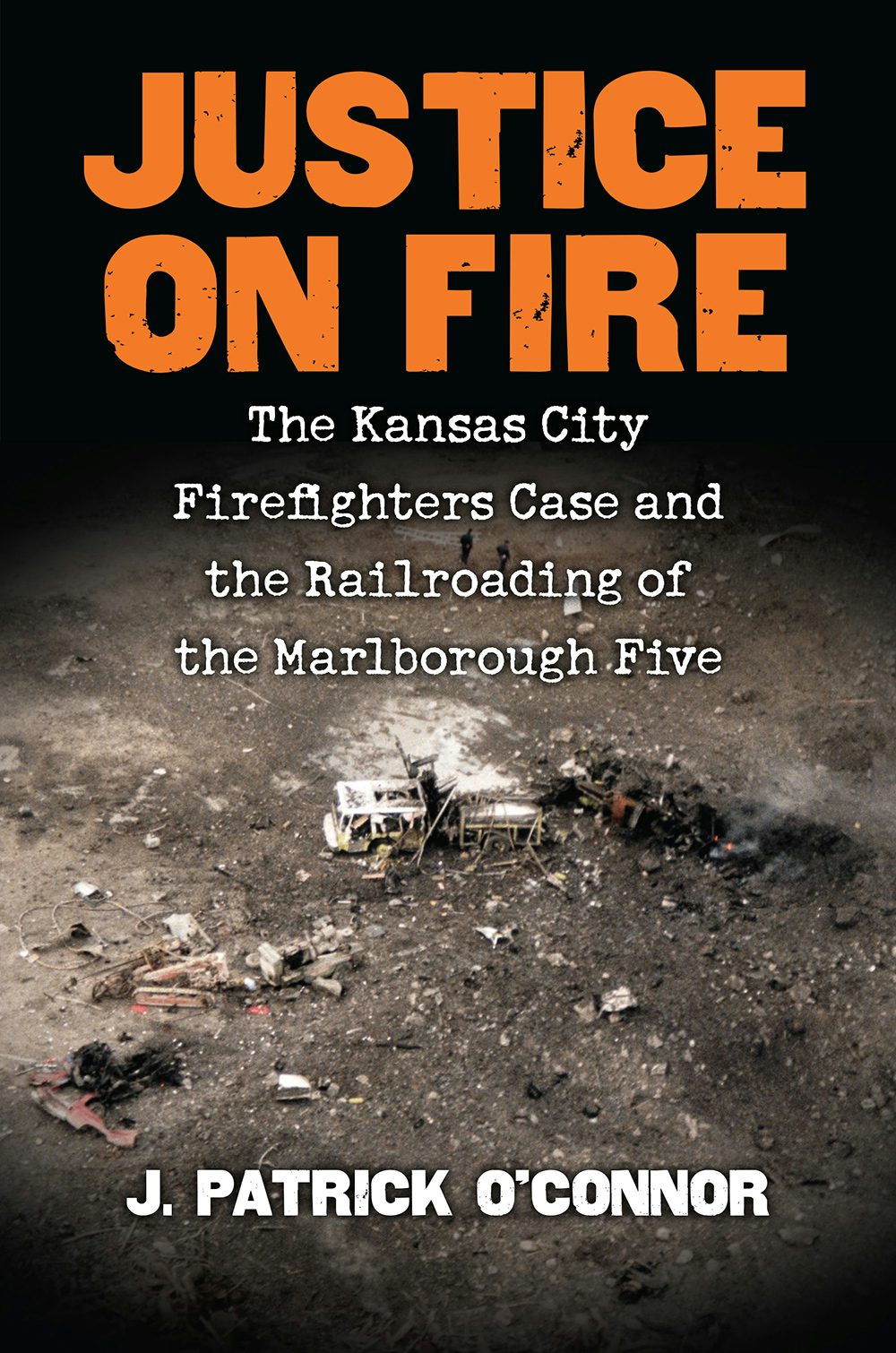
The Firefighter Case: Part I

South Kanasa City Blast Site

Five innocent people were convicted in February 1997 in the deaths of six Kansas City firefighters in 1988.  These two stories run a total length of 20,000 words, and won the Missouri Bar Association's annual "Excellence in Legal Journalism" award. On Oct. 30, 1998, the 8th U.S. Circuit Court of Appeals denied the appeal in the Kansas City Firefighters case. Read the full opinion here and our analysis of the opinion. On Oct. 4, 1999, the U.S. Supreme Court declined to grant certiorari in the case.

by J.J. Maloney

The Execution Photos

Allen Lee Davis

[Ed's Note: On Jan. 14, 2000, following the barrage of controversy created by the execution photos posted by Justice Shaw, Florida barred any further executions by electrocution, opting for lethal injection. On Dec. 16, 2006, then Gov. Jeb Bush suspended all executions in Florida after it took two doses and 34 minutes for Angel Diaz to die by lethal injection.]

 by J.J. Maloney


The execution of Allen Lee Davis in the Florida electric chair on July 8, 1999, was so violent that it set off a shock wave that rippled around the world. When the Florida Supreme Court ruled, yet again, that execution by electrocution is not unconstitutional, a dissenting justice attached three photographs of the execution to his dissent and posted them on the Florida Supreme Court web site.

The photographs drew attention from all over the world, with many foreign visitors expressing disgust, while many Floridians rallied in support of "Old Sparky," as the Florida electric chair is known. One Florida woman, in an email to the court, described the photographs as "wonderful."

Each person can view the photographs, and read the following lengthy excerpt from the dissent of Justice Shaw and come to his or her own conclusion as to the propriety of capital punishment, and electrocution in particular. As Justice Shaw points out, the United States is the only country in the world that uses electrocution as a means of execution, and even in the United States only three states still use this method of execution.

The Murder of JonBenét Ramsey

May 7, 1999 Updated 8/30/06 and 07/20/08

by J. J. Maloney & J. Patrick O'Connor

Related Story: Solving the JonBenet Case by Ryan Ross. (04/14/03)


Editor's Note:

On July 9, 2008, Boulder County District Attorney Mary Lacy stated that DNA tests conducted by Bode Technology Group revealed that skin cells left behind on JonBenet Ramsey's long underwear point to a killer other than the girl's parents, John and Patsy Ramsey, or her brother, Burke. Mrs. Ramsey died of ovarian cancer in 2006 at age 49.

"To the extent that we may have contributed in any way to the public perception that you might have been involved in this crime, I am deeply sorry," Lacy wrote in an exoneration letter to John Ramsey, who now has remarried and lives in Michigan. "No innocent person should have to endure such an extensive trial in the court of public opinion."

Early in the investigation into the 6-year-old pageant star's brutal murder on Christmas night in 1996, Lacy said that Boulder police discovered male DNA in a drop of blood on JonBenet's underwear that did not match any members of JonBenet's immediate family. The tests conducted by Bode Technology Group, Lacy said, revealed the same DNA that was found previously in the drop of blood was present in three places on JonBenet's long underwear.

Lacy stated that Boulder investigators now hope they'll eventually find a DNA match in the ever-expanding national DNA databank, a sentiment echoed by John Ramsey. "I think the people that are in charge of the investigation are focused on that, and that gives me a lot of comfort," Mr. Ramsey said in an interview with a Denver TV station. "Certainly we are grateful that they acknowledged that we, based on that, certainly could not have been involved."

Even if a DNA match is eventually made, it does not mean that the DNA from this contaminated crime scene will reveal it to be that of JonBenet's killer, although it possibly could. For now, all that is known, is that it is not the DNA of John, Burke, or the late Patsy Ramsey. In the meantime, the JonBenet case will continue unsolved and will remain one of the most botched crime investigations in the annals of U.S. law enforcement.


The brutal murder of 6-year-old JonBenet Ramsey on Christmas night in 1996 shocked America to its core. Just as the Lindbergh baby kidnapping and murder seven decades earlier had seared the nation's consciousness, this murder – of a beautiful and talented child in a wealthy Boulder, Colo., home – renewed every parent's worst nightmare: No child was truly safe, not even tucked in at home on Christmas night.

JonBenet's murder – particularly as the days went by and no arrests were forthcoming – quickly became a national obsession, featured day after day on network news, television tabloid programs, talk radio, newspapers and magazines. Her image flitted across television screens innumerable times, often showing her in a fancy red cowgirl outfit, singing "I want to be a cowboy sweetheart," or dancing across the stage in a glittering Las Vegas showgirl outfit, complete with heavy makeup. Her unusual first name became so well known that like Cher and Madonna she no longer had need of a last name.

The public's shock at the murder soon began to share equal time with its growing dismay at the Boulder police's investigation, a dismay fed by a steady stream of leaks from the Boulder County District Attorney's office about the inept police investigation being conducted. For one thing it became known that the police had badly botched the initial investigation by failing to seal off the crime scene. For another it appeared the police were treating the primary suspects – JonBenet's parents – with kid gloves by not only acquiescing to their refusal to be interviewed at police headquarters, but also to being interviewed separately. Fueled with such information, the media, especially the tabloid television and talk radio shows, were showing no such restraint toward the glamorous child's parents, John and Patsy Ramsey. Some in the media began to point the finger directly at her father. Others implied it was her mother who had garroted the girl. Some speculated the crime had to have been committed by both parents. The tabloids even raised the possibility that her brother Burke, who was just shy of 10-years-old at the time, murdered JonBenet.

The Abbott Impact

Jan. 23, 2012

Jack Henry Abbott

Jack Abbott sold himself to Norman Mailer as the “Super Convict.” Mailer turned the letters Abbott sent him into the best-selling book, In the Belly of the Beast, and assisted Abbott in gaining parole in 1981. Six months later Abbott stabbed a waiter to death in a New York restaurant.

 by J.J. Maloney

Jack Henry Abbott started as a boy in a training school, worked his way up through the system-—getting in trouble here, being transferred there, getting into more trouble until, ultimately, he spent virtually all of his life in some form of reform school or prison.

When it became known in 1977 that Norman Mailer was to write The Executioner's Song, about Gary Gilmore, Abbott, who was incarcerated in the same Utah penitentiary, wrote to Mailer, suggesting that Mailer could make use of the observations of someone like Abbott, someone who had lived in the world Gary Gilmore inhabited.

Mailer began to correspond with Abbott, and apparently began to care about him. Abbott wrote long, grandiloquent letters, in which he discussed his fantasized perception of himself as a Super Convict. He claimed to have been subjected to more brutality than other convicts, to have risen higher above the situation than other convicts, to have been more philosophically correct than other convicts.

Mailer bought it; for his own reasons, he wanted to believe what Abbott was saying. And, of course, there was some truth in many of the things Abbott said about prisons. 

An Analysis of the 8th Circuit Opinion in the Firefighters Case

South Kansas City Blast Site

by J.J. Maloney

On Oct. 30, 1998 the 8th U.S. Circuit Court of Appeals denied the appeal of five defendants convicted of causing the deaths of six Kansas City firefighters in 1988. The defendants, Darlene Edwards, Frank Sheppard, Earl (Skip) Sheppard, Bryan Sheppard and Richard Brown, were sentenced to life imprisonment without possibility of parole.

For months the defendants, and their attorneys, had been hoping the 8th Circuit’s lengthy deliberations might lead to a new trial. The case was argued before the 8th Circuit on April 15, 1998. At time of oral argument, the three judge panel had sharply questioned Assistant U.S. Attorney Paul Becker, head of the Organized Crime Strike Force in Kansas City, who had prosecuted the case. This sharp questioning caused many to believe the 8th Circuit would overturn the convictions.

The Great Brinks Robbery

At the time, the Brinks heist in Boston was called "the crime of the century." The take of over $2.7 million was the largest in U.S. history, but it was the cold, calculating efficiency of the robbery that so stunned and intrigued the nation.

by J.J. Maloney

On January 17, 1950, at 7:30 p.m., a group of armed robbers walked away from the Brinks Building, at 165 Prince Street in Boston, with $1,218,211.19 in cash and more than $1.5-million in checks, money orders and other securities.

It was a textbook robbery – the largest in U.S. history at the time. There had been seven robbers – all wearing Navy P-coats, gloves and caps, and Halloween masks. They wore rubbers and crepe-soled shoes.

The robbers said little and knew exactly what they were doing. They'd come through a series of locked doors to reach the second floor, where Brinks employees were counting and storing money.

The only evidence was a chauffeur's cap one of the robbers left behind, and the tape and rope they'd used to gag and tie up the employees. They also took four revolvers from the employees.

The Greenlease Kidnapping

Robert Cosgrove "Bobby" Greenlease, Jr

A sensation of 1953, $300,000 of the $600,000 paid in ransom has never been recovered.  Two police officers and a gangster are commonly thought to have stolen the money -- but did they?  

by J. J. Maloney

One of the more tragic and fascinating crimes of the mid 20th century was the kidnapping and murder of 6-year-old Bobby Greenlease in 1953, and the subsequent disappearance of half the $600,000 ransom his family futilely paid for his release.

Bobby was the son of Robert C. and Virginia Greenlease. His 71-year-old father was one of the largest Cadillac dealers in the nation. The Greenleases lived in Mission Hills, Kan., the most elite suburb in the Kansas City area.

The kidnappers – Carl Austin Hall and Bonnie Brown Heady – had both known privilege earlier in their lives. In fact, it was at military school that Hall met Paul Greenlease, the older, adopted brother of Bobby Greenlease. Hall later inherited a substantial amount of money from his father, but blew it failing at a number of business ventures. For robbing a number of cab drivers – his total take was $38 -- Hall was sent to the Missouri State Penitentiary. In prison he dreamed of making "the big score" – a score that would allow him to once again live in luxury.

He later said that kidnapping was the only crime where he could strike once and retire for life.

Syndicate content